Grease trap installation cost is driven by the size the state requires for your kitchen, not your preference. In Connecticut, food establishments discharging to a sewer are covered by a Department of Energy and Environmental Protection general permit. It sets a minimum interceptor volume of 1,000 gallons and requires 24 hours of retention at maximum daily flow. This is why a small cafe and a full-service restaurant often get quotes closer than owners expect.
We at A-Team Plumbing and HVAC install, replace, and service grease interceptors for commercial kitchens across North Branford and central Connecticut. Request a quote, and we will size the unit against your actual fixture count and flow.
Who Needs a Grease Trap in Connecticut
If your kitchen produces grease-laden waste and discharges to a public sewer, you almost certainly need an interceptor. The International Plumbing Code, on which Connecticut’s building code is based, requires a grease interceptor or an automatic grease removal device to receive drainage from fixtures and equipment that discharge grease-laden waste in food preparation areas. That covers restaurants, hotel and hospital kitchens, school kitchens, bars, cafeterias, and bakeries.

Connecticut adds a second layer on top of the plumbing code. The state’s general permit for food establishment wastewater applies to Class II, Class III, and Class IV food establishments, and it accepts three compliance paths:
- An outside in-ground grease trap or interceptor, the conventional solution for a full kitchen
- An active grease recovery unit (AGRU), which removes grease mechanically and continuously
- A super-capacity grease interceptor (SCGI)
Grease Trap Services We Provide
New grease trap installation
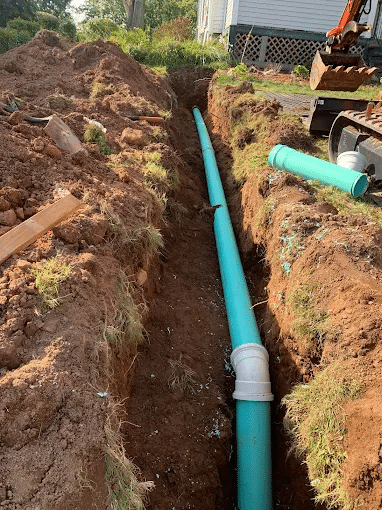
We handle sizing, excavation, setting the tank, inlet and outlet piping, venting, and sewer connection. Connecticut’s fact sheet for outdoor in-ground interceptors sets a minimum liquid depth of 4 feet, 4-inch minimum inlet and outlet piping, and tee fittings extending within 12 inches of the tank bottom and at least 5 inches above the liquid line. Inspectors check these details.
Grease trap replacement
Older units fail by cracking, losing baffles, or being undersized for a kitchen that has grown since installation. Replacement also updates non-compliant legacy traps to meet the current 1,000-gallon minimum.
Undersized and non-compliant trap upgrades
If you have been cited or are buying a building with an existing trap, we assess it against current requirements and tell you if it can stay.
Pumping, cleaning, and maintenance scheduling
Installation is the smaller part of the obligation. Most violations occur due to the pumping requirement below.
What Grease Trap Installation Costs
There is no reliable national price list for grease trap installations. Any page quoting one without a source is guessing. We can identify the variables that affect cost and then provide a specific figure for your site.
What Drives Grease Trap Installation Cost
| Cost driver | Why it moves the price |
|---|---|
| Required capacity | Set by 24 hour retention at max daily flow, minimum 1,000 gallons |
| In-ground versus AGRU | Excavation and tank versus a mechanical unit and its connections |
| Excavation and access | Parking lot, sidewalk, or tight rear alley all price differently |
| Plumbing rework | Re-routing kitchen waste lines to the interceptor |
| Permits and approvals | Sewer authority permit plus building inspection |
| Surface restoration | Paving, concrete, or landscaping after the dig |
Two things to know before comparing quotes. A bid that does not specify capacity is not comparable because capacity is the primary driver and set by regulation, not preference. Most Connecticut sewer authorities require their own permit for an in-ground interceptor, separate from the building permit.
Request a quote, and we will size the unit and price the work in writing.
Connecticut’s Grease Rules Decide Your Installation, Not Your Kitchen Size

Most operators assume the trap is sized to the restaurant. In Connecticut, it is sized to a state rule with a hard floor. The general permit for wastewater discharge from food establishments, issued by the Department of Energy and Environmental Protection and effective October 5, 2025, requires retention of at least 24 hours at maximum daily flow with a minimum of 1,000 gallons regardless of kitchen size.
That floor is why a coffee shop and a diner can have the same tank size. It also means the useful question for a quote is not how big your restaurant is but what your maximum daily flow is across your fixtures, since anything above the floor scales from there.
The maintenance requirement is stricter than most operators expect and is where citations come from. The permit requires the interceptor to be completely emptied whenever 25 percent of the operating depth is occupied by fats, oils, grease, and settled solids, or at least once every three months, whichever is more frequent. Written records of inspections, depth measurements, and pumping must be kept on site for five years. A facility can request a longer interval only after a year of quarterly inspections showing an accumulation of less than 25 percent.
Enforcement is both local and statewide. Area authorities, including the Greater New Haven Water Pollution Control Authority, require their own permit for in-ground installation. The Town of North Branford’s sewer guidance asks residents and businesses not to put grease into the system because it solidifies, collects debris, and accumulates in town lines. The EPA reports grease as the most common cause of sewer blockages at 47 percent.
What Commercial Customers Say About Us
Neither review below is from a grease trap job. Both are residential calls, and we do not imply otherwise. They show what a commercial buyer evaluates when comparing installers: whether the person quoting explains the problem, the cost, and the options before starting.
A-Team Plumbing Will Be Our Go-To
Patty Stevens had a plumbing problem and needed to understand both the fault and the price before committing. Our technician, Taylor, diagnosed it, explained the issue and the full repair cost, and completed the work quickly.
“Taylor was wonderful to work with. She never left out a detail when explaining what the issue was and the cost to repair. She fixed our problem quickly.
A team plumbing will be our go to place for any issues in the future.”
For a commercial kitchen, the same discipline matters more. A grease trap installation affects your sewer connection, kitchen downtime, and compliance record. The details you want upfront are capacity, permit, excavation, and restoration, priced separately so you can see what you are paying for. Read Patty’s full Google review.
Explained Every Detail of the Process With Various Options
Gabrielle Edman’s review describes the other half of a good quote: being given choices instead of a single number. Taylor walked her through the process and laid out available options rather than presenting one path.
“Taylor was amazing! She was incredibly personable and professional. She explained every detail of the process and gave me various options. I am so pleased with her assistance!”
On a grease trap that translates directly. In-ground interceptor, active grease recovery unit, and super-capacity interceptor are three compliance paths with different costs, footprints, and maintenance burdens. An installer who presents only one usually chooses the easiest option. Read Gabrielle’s full Google review.
Why Commercial Kitchens in Connecticut Work With Us
A-Team Plumbing and HVAC is a Connecticut-licensed plumbing contractor #P1288989 at 2 Commerce Drive in North Branford. We have served commercial and residential customers across central Connecticut since 2018.
- Licensed and insured in Connecticut under the P-1 unlimited plumbing contractor class, which covers all plumbing and piping work in the state
- We size to the regulations based on your fixture count and maximum daily flow, not a rule of thumb.
- We handle the permit, including the sewer authority approval and the in-ground interceptor requirements.
- Written pricing with capacity, excavation, permit, and restoration itemized separately
- Maintenance scheduling built around the 25 percent and three-month requirement so compliance does not depend on someone remembering
Schedule a Grease Trap Quote
If you are opening a kitchen, replacing a failing interceptor, or have been told your existing trap is undersized, the sizing conversation should happen before the build schedule is set. We serve North Branford, Northford, and surrounding Connecticut towns. We handle installation and the ongoing pumping schedule.
Request a quote, and we will size the unit for your kitchen and provide a written price quote.
FAQs About Grease Trap Installation in Connecticut
How much does grease trap installation cost in North Branford?
There is no reliable published national figure, and any page quoting one without a source should be treated with caution. Cost on a real job depends on required capacity, whether you install an in-ground interceptor or an active grease recovery unit, excavation difficulty, access, kitchen waste line rerouting, permits, and surface restoration. Because Connecticut sets a 1,000-gallon minimum, capacity has a floor that a very small kitchen cannot price below. We provide a written quote after sizing the unit to your fixtures.
What size grease trap does Connecticut require?
The Connecticut general permit for food establishment wastewater requires a retention time of at least 24 hours at maximum daily flow, with a minimum of 1,000 gallons, whichever is greater. For outdoor in-ground interceptors, the state also specifies a minimum liquid depth of four feet, 4-inch minimum inlet and outlet piping, and tee fittings extending to within 12 inches of the tank bottom and at least 5 inches above the liquid level. Sizing is calculated based on your fixtures and flow, not on seating capacity or square footage.
How often does a grease trap have to be pumped in Connecticut?
The state permit requires the interceptor to be completely emptied whenever 25 percent of the operating depth is occupied by fats, oils, grease, and settled solids, or once every three months, whichever comes first. The “whichever is more frequent” clause is the operative part and often missed. You must also keep written records of inspection dates, who inspected, measured depths, and maintenance performed, which must be retained on site for five years.
How much does a 1,500-gallon grease trap cost in Connecticut?
Any flat figure is a guess because the tank is the smaller part of the total. A 1,500-gallon interceptor is the next standard size above the state minimum and usually matches the 24-hour retention calculation when flow exceeds 1,000 gallons. The price increase for the tank is modest. What affects the cost is sitework: excavation depth and width, access for the set, waste line rerouting, whether covers must be traffic-rated, and surface restoration. We provide a written quote after sizing to your fixtures.
Do I need a permit to install a grease trap in North Branford?
In most Connecticut service areas, yes, and often two. The building department issues a plumbing permit for the work, and the sewer authority issues its own approval for an in-ground interceptor connecting to the public sewer. In the Greater New Haven service area, for example, the water pollution control authority requires a permit for in-ground installation. It expects sizing to follow the state fixture-based method, while explicitly not sizing or approving the units itself. We confirm which approvals apply at your address before we quote.
Can I use an under-sink grease trap instead of an in-ground interceptor?
Sometimes, but it depends on your flow and on what your sewer authority accepts. Connecticut’s general permit recognizes active grease recovery units and super-capacity interceptors as alternatives to a conventional outside in-ground trap, so there is more than one compliant path. Smaller hydromechanical units are rated under standards including PDI G101 and ASME A112.14.3, and the rating is what determines whether a given unit satisfies your calculated requirement. The deciding factors are your maximum daily flow and your local authority’s position, not preference.